The Long Emergency
A report on the January 15, 2026, regular council meeting
The draft minutes of this meeting are posted on the Village website. Thank you, Rachel!
Audio Upgrade
President Wilkins debuted a headset microphone at this meeting, and it was a lot easier to hear her. The Alert recording is still a bit quiet, despite my own new microphone. Someday I will learn how to edit audio files. I did merge two files for the first time, which I had to do because I accidentally stopped recording during Ken Mlcek’s presentation on the water asset geographical information system (GIS), see below. I think a couple of words may have gotten cut off.
There’s an attendance sheet on the table at the front of the meeting room for guests to sign as they enter. No one is required to sign it, but it’s helpful for the clerk, especially if an attendee intends to make a public comment. It’s been customary in Elberta, but it’s not required, to include in the minutes the names of members of the public and those who make a comment; the clerk is not required to summarize or state the topic of the comments, but some clerks do. The State of Michigan gives broad discretion to municipalities and councils to decide what to include in their minutes, and some are bare bones. It can be helpful for historical, recordkeeping, and legal reasons for a local government to note who was present at a meeting and whether they said something in particular. Some councils like detailed minutes, some don’t. What is required by law is simply that all the official acts and decisions (motions and votes) made during the meeting be recorded, and, especially in the case of zoning board of appeals decisions (as our council was told in training), it can be important to include valid justifications or reasons for decisions. Really, reporting in more detail on meetings is the job of the press, not the clerk. That’s why we have the Open Meetings Act: so members of the public and journalists have easy access to meetings and to all materials that are matters of public record. Anything that happens, is said, or is presented during open session of a public meeting is fair game. It’s a sacred space, ground zero for democracy.
The new computer software and scanners in the office were supposed to make it easier to share electronic versions of materials and information with council members and residents and utility customers online. In the past, there has also been a paper meeting packet available at the office for residents to look at. I don’t know if that’s still the case, because I haven’t been down there in a while. The Village of Beulah, the city of Elk Rapids, and Benzie County all make their meeting packets available online ahead of their meetings so the public can view them and be prepared to fully participate. If the paper meeting packet is ready on Monday for council members to pick up, it seems like it should be ready for the rest of us to see then.
The reason I’m wondering about all this is that I emailed our clerk asking if I could see the new commission application interview policy after I saw it as an item on the agenda in the post office. I didn’t see the agenda until the day before the meeting, so I wasn’t surprised that I didn’t hear back from her. Since I had applied for one of the two planning commission seats, and “Planning Commission Applicants A&B” were on the agenda, I thought it might be interesting for me to read this policy. I didn’t know before the meeting whether I was one of the applicants being considered. Should I shower?
If you ever listen to the meeting recordings you’ll notice that it can be real hard to tell what’s going on if you don’t already know—that is, if you aren’t on council and you don’t have the packet in front of you. And, since I was on council once, I can say that it’s sometimes pretty confusing even if you do have the packet. I didn’t have a much better idea of what was involved in this application policy after attending the meeting than I did before, or about several other things that were discussed; the policies and other material weren’t read aloud and they weren’t available at the meeting to look at. So after the meeting I emailed the clerk asking for a paper or electronic version of all the meeting packet materials, whichever was easiest, and she told me I would need to submit a FOIA request. Since I had already essentially submitted a FOIA request by writing the email and asking for the packet materials and I didn’t know how to get more specific about the packet materials, I decided to get them a different way.
Approval of the Agenda
During agenda approval, Wilkins amended the agenda by adding another applicant to the Unfinished Business item: Planning Commission Membership Applications A & B. This was presumably the application dated January 7 from Jill Fogg, which was in the packet materials, along with two other applications, one from me dated November 3, and one from Dan Carter dated November 22; Wilkins did not say who any of the applicants were during the meeting. More on that later. Now on with the meeting.
Correspondence
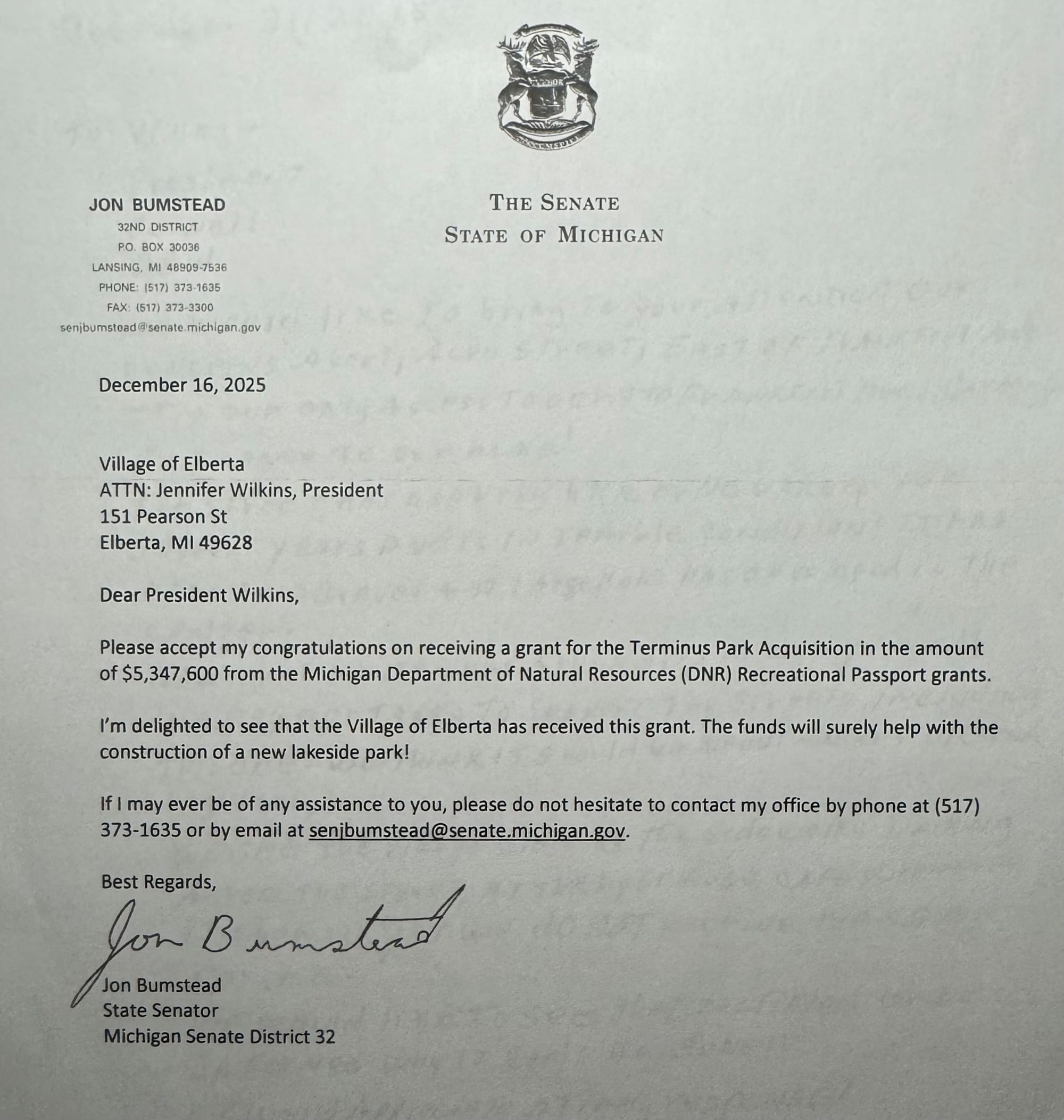
Wilkins read a letter from State Senator Jon Bumstead, congratulating us on the $5.3 million grant to acquire “Terminus Park.”
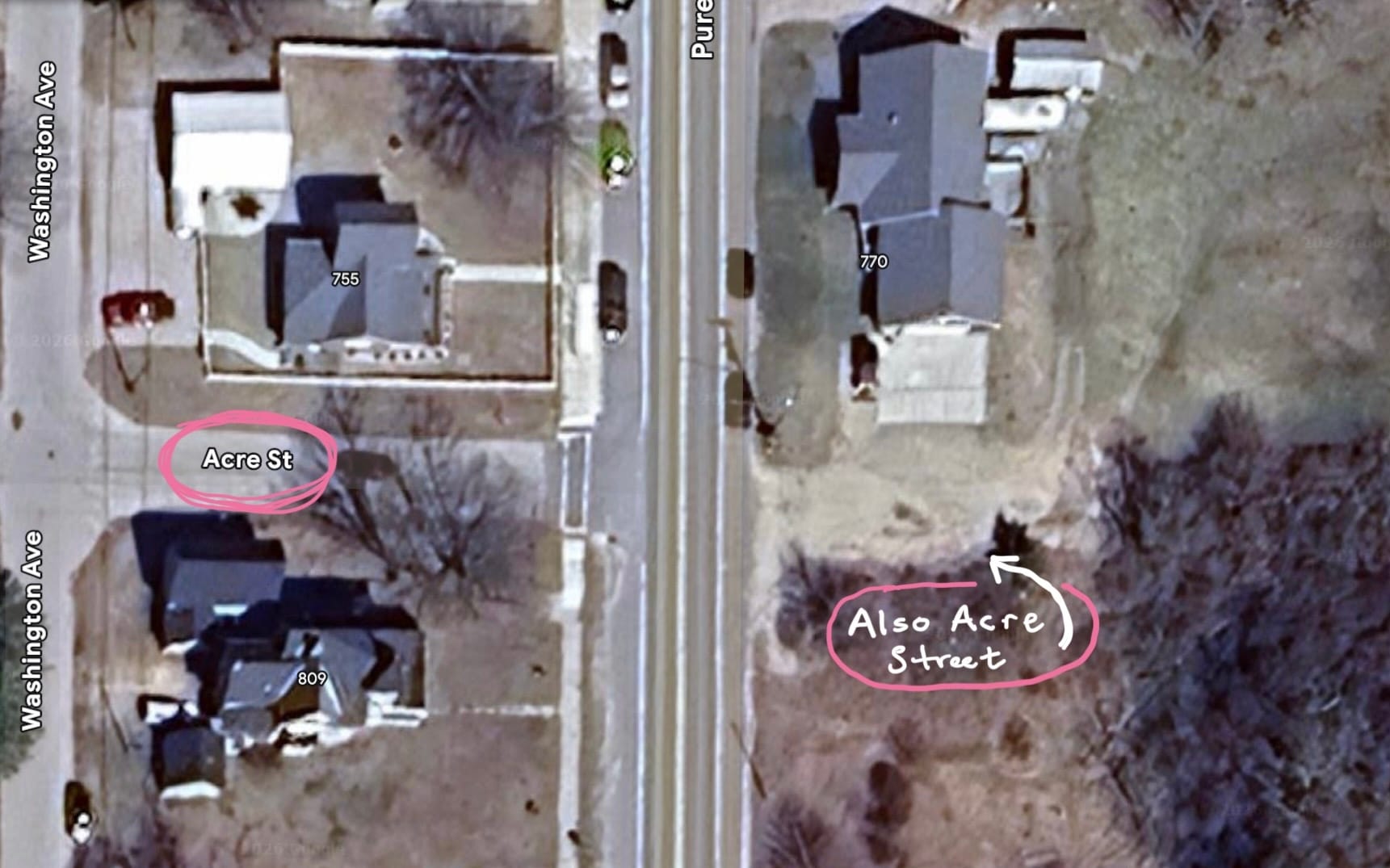
Art and Joan Moseler had written to council about the state of the east end of Acre Street along M22, which has been a sore spot for several years, they noted, as it’s unpaved, has a large pothole, has been unplowed, and is the only way they can get to their driveway. Chris Cervantes had already addressed the plowing concern by the time of the meeting. At some point I’d like to find out whether there’s a plan to pave that section of Acre and how far if so. Perhaps it is in the capital improvement plan.
Housing Trust of Benzie Presentation
During Correspondence we heard from two board members of the Housing Trust of Benzie (HTB), formerly known as the Frankfort Community Land Trust (our trustee Ryan Fiebing, an architect in daily life, is also on the board). Bree McGregor, erstwhile Elbertian, author of our winning Terminus Park grant, and now vice president of HTB, spoke on the ongoing housing scarcity crisis in the county and how her organization is attempting to bring housing opportunities for middle-income working families to Elberta. She said the median income in Benzie is about $72K, and the median house price last year was just over $500K. Jay White spoke next. He’s the immediate past president and oversees home construction, land procurement, and sales. He described the housing trust’s Grove Place homes (behind A&W), which were completed and fully occupied as of last year and sold for about $210K each, and the four Cottages at Corning, also in Frankfort, which are well underway. White says HTB is looking for parcels to buy in Elberta to begin new construction this summer, and that HTB would consider helping the Village out by removing blighted properties. Once the property is acquired, the housing trust owns the land, but the homebuyer owns and can sell the house, with some restrictions. HTB is hosting a Community Conversation about housing challenges and solutions in Benzie County at the Mills Community House on February 11 (a Wednesday) from 5:30 to 7:30. [1/30/26 Margie DeVine is now president of the board of HTB; Amy Schindler has joined the board, and a new education and outreach committee is headed by Stephanie Williams.]

Fire & Safety Report
In addition to hearing Chief Cederholm’s report at the meeting, I did get some information directly from him, not from the packet.
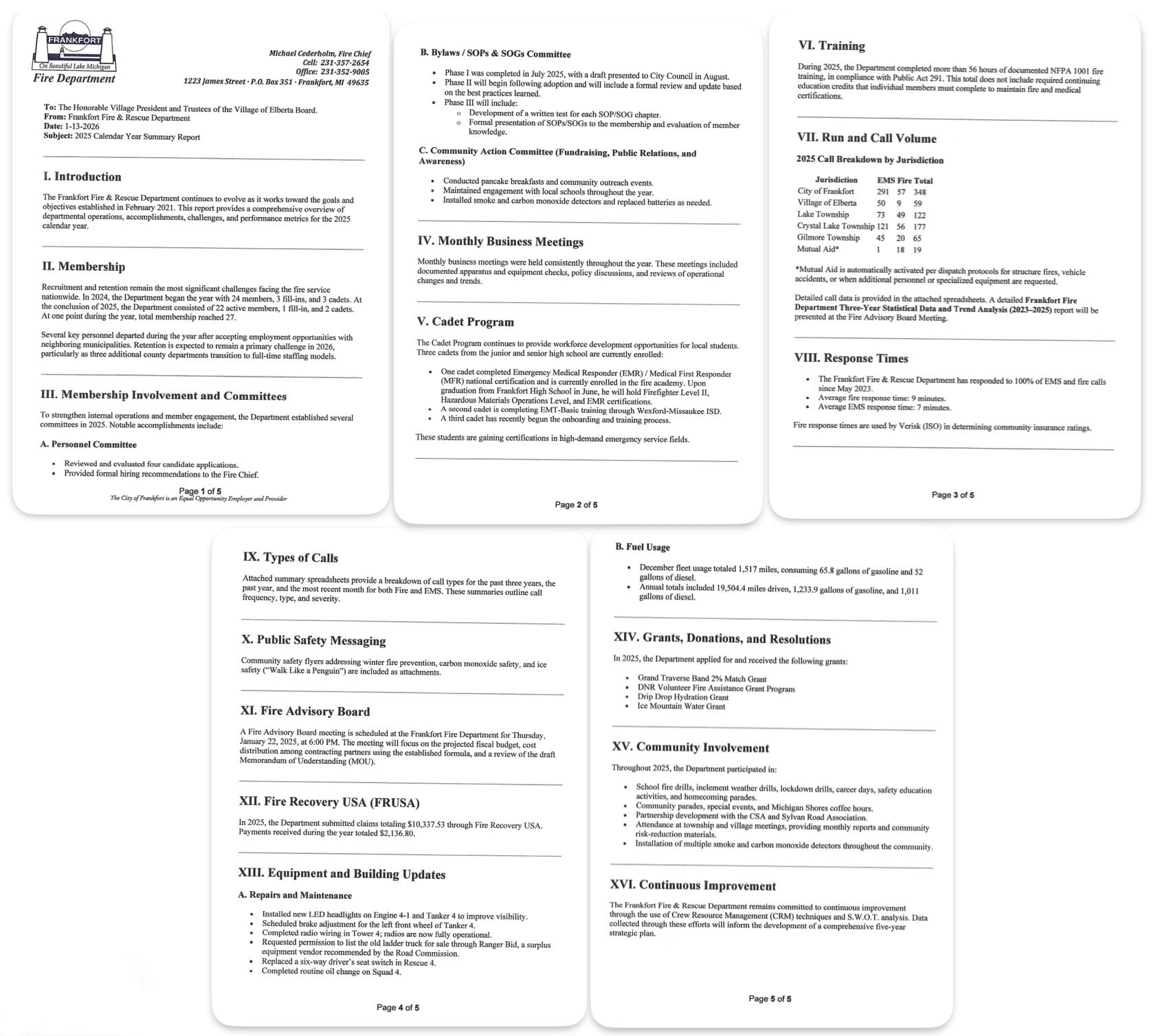
There were no fire calls in Elberta this month.
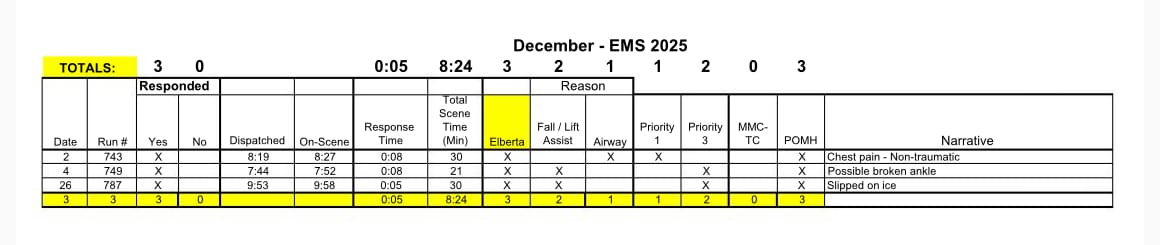
Cederholm said the department began the year with 24 members and currently has 22; when he started his chiefdom there were only 10. They have a personnel committee now to review applications. SOPs and SOGs, initialisms for standard operating procedures and guidelines, are required by MIOSHA and NIOSH, acronyms for the Michigan Occupational Safety and Health Administration and the National Institute for Occupational Safety and Health. City Council will review them and once they’re approved and adopted a written test will be developed for the department members to take annually. May 31 has been locked in as the pancake breakfast fundraiser date at the Mayfair Burger Bar; Cederholm thanked Nick and Natalie Crawford for graciously extending their facility again this year. Three fire cadets are enrolled from the junior and senior high school program. One is certified now in citizen’s emergency response, is a medical first responder, and is in the fire academy; when he graduates he’ll be a firefighter level 2, a hazmat operations level 1, and a nationally certified emergency medical responder. Another candidate, also a senior, is in EMT basic training in Wexford-Missaukee ISD and is expected to enroll in the fire academy. The youngest currently is 15, but 14-year-olds can apply for the program. The fire advisory board meeting was Thursday, January 22. Fire Recovery USA got the department about $2,000 in unpaid fees related to crash responses. New LED lights were put in the trucks. They are trying to sell the old ladder truck. “You could use it to put the Christmas decorations up!” Cederholm suggested.
Initial Public Comment
Arlene Sweeting requested that issues raised in public comment be noted in the minutes, so that, for instance, if a council member is absent they would still be informed that a member of the public had raised the issue.
Approval of Bills
Wilkins recused herself from the payroll vote, as she has for a couple of years now since she began earning a wage performing administrative duties in the office under the auspices of a resolution first passed in 2023. I myself earned some money performing clerk duties for a time in between clerks, and when I was on council Wilkins and I had to do this weird recusal switch off during the payroll vote for a couple of months. I haven’t put in nearly the number of hours that Jen has in service to the Village. In 2022 I earned $328.70 (all council meeting pay); in 2023 it was $878.64 (some of this was meeting pay and the rest was minutes and short-term rental coordinator work); in 2024 I earned $3,316.68 (council meeting pay plus minutes, short-term rental coordination work, and work in the office after Kat Ralston’s resignation). In 2025, I received $70.48 in meeting pay. I still have the check register reports from any of these years if people would like to see them. I think people should definitely get paid for fill-in work or contract work outside the scope of their official duties, and in that sense I think the idea behind the resolution is sound. My understanding was that the fill-in work by officials was to be very temporary, used in emergencies when we were having trouble hiring employees to fill these positions—like for example when there weren’t even any applicants for advertised positions. But there’s no time limit stipulated in the resolution for officials to act in this capacity, beyond the fact that the resolution must be renewed every year at budget time.
When the person doing the fill-in work also drafts the budget, interviews, hires, and manages the employees, sits in on personnel meetings, presents policy to council, and writes the resolutions that need to be written to allow the fill-in work to be paid for, it would seem there’s a real danger of an appearance of self-dealing, and I made a public comment to this effect at the November meeting, and also asked whether council had been involved in the decision to hire a part-time rather than a full-time treasurer, and whether any effort had been made to fill the council seat I vacated in June. Since then, Ryan Fiebing has been added to the Budget Committee, so there’s at least one other member of council with eyes on finances. In a January 8 email to the clerk I followed up on whether anyone had applied for the council seat and I didn’t get a response. I’m catching a whiff of eau de lack of transparency. Or maybe it’s just me. I sound like Andy Rooney!

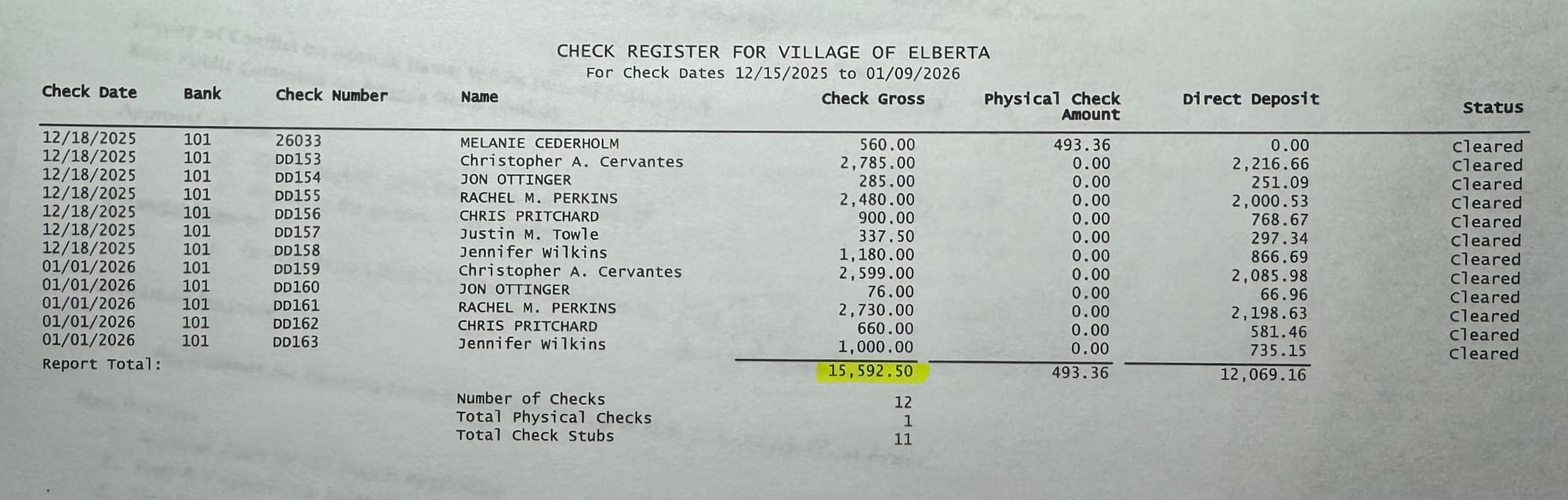
The revenue and expense report for the Village is 16 pages long, and I didn’t feel like photographing it and turning it into a pdf. It’s technically easy for the office to export it as a pdf from BS&A and put it on the Village website. That would be nice, especially as we approach the budget hearing, which is scheduled for February 19 at 6:30, thirty minutes before the meeting at which the budget is expected to be approved. Look for a draft budget sometime soon. During final public comment, Arlene Sweeting asked if the budget meetings would be open to the public and posted, and Wilkins said they would. Today as I wrote this, a post went up on the Village website, and there’s a budget meeting this coming Tuesday morning, January 27, at 8:30 a.m. at the Community Building. I might bring doughnuts. You heard me.
The MiClass investment statement for December showed us with a total of $786,840.37 among 11 different funds, with an average monthly yield of 3.9473%.
Unfinished Business: Applications for Planning Commission Membership A & B — and Newly Added C
This was unfinished business because it had been on the agenda in December, and Wilkins had moved to table the item until January at that meeting because she said she wanted to meet with the candidates first. At the time of the December meeting there were two candidates, Dan Carter and I, and we both had applied in November, for two open seats on the commission. Council agreed to table the item so Jen could meet with us. In December, the planning commission was down to a bare quorum of three members to finalize the zoning ordinance and hold a public hearing. This milestone, when it’s reached, will come at the end of several years of unpaid1 work by Ryan Fiebing (the council liaison to the commission), and all the members of the commission past and present who dedicated hundreds of excellent, careful hours of their time to getting us here. It’s a lot to ask of five people, let alone four—or three. I’ve got plenty to do, but when I heard there was a vacancy, I applied right away.
“These are the applications of the people who have applied,” Wilkins began on this mid-January night. “We have three applicants now. And we will consider the recommendations at the February meeting.”
Fiebing said: “On that, I would just like to state that while I understand that we’re going to review a new policy to guide the process for appointments to our boards and committees, I would like to express my frustration with how long it’s taking. Planning Commission has had two vacancies for some time, one vacancy for almost three months now, and we’ve had qualified applicants that could have filled those seats, especially during this critical time when we’re nearing completion of our draft zoning ordinance and a public hearing, so the help would be very appreciated. I think the previous long-standing ad hoc process of having the planning commission review applicants and provide recommendations to Village Council for appointment could have been utilized during this time while we prepare this new policy for the future. And I think it would have been great if we could have discussed appointing at least applicants A & B during this meeting. But. I understand.”
“Thank you. Thank you very much.” Wilkins said. “All right. Moving on to New Business No. 1, Ironman 2026.”
Ironman Is Happening Again
M/22 Lake Street will be partially closed from Frankfort Avenue to River Road in Elberta on September 20 from 7 am to 7 pm.
So yeah, I don’t give a rat’s ass about Ironman. I know a lot of people do, and I’m happy for them.
Fleis & Vandenbrink: Water Asset Management
Anyway, I was glad I at least had this quiet recording because during the meeting IRL, while Ken Mlcek was talking, I was just sitting in stunned silence. Listening to the recording later, I had a renewed appreciation for all that Ken has done for us and what a huge undertaking this water project has been—hearing his summary of the whole project, I felt like I actually finally understood it. President Wilkins has also put enormous energy and dedication into this and so many other crucially important projects in the Village, and certainly has not been adequately compensated for her time. I’m happy to see in the Personnel and Policy minutes that there’s a plan developing for a Volunteer group. Maybe this will mean more of the load can be shared as we continue to grow. As many Villagers as possible can feel real ownership of Big Projects—and there will be more of them, soon—and celebrate them every step of the way.
Our hero Ken Mlcek has been doing mostly grant-funded work for the Village for two years and he’s nearly done, so this night he gave a presentation on what’s been accomplished. He had a projection of the interactive system and a paper map showing our water system for demonstration purposes. I’ll mostly paraphrase what he said. Some of this, if you’ve been reading these reports, you’ve heard bits and pieces of before.
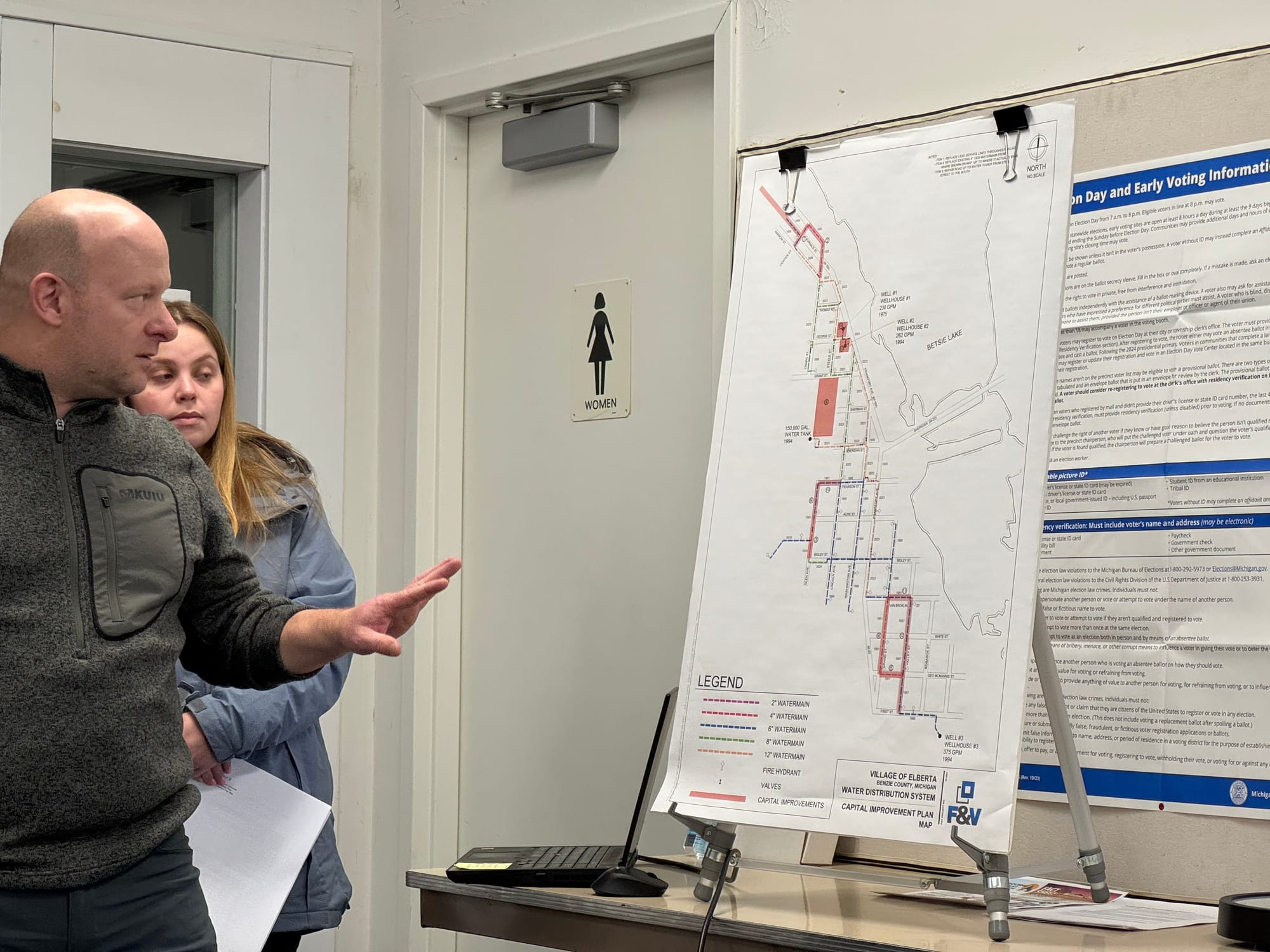
A distribution system materials inventory is required by EGLE for all communities; we got that done with grant funds with Mlcek’s help. F&V also created a geographic information systems (GIS) model of the water system, which Mlcek showed on the screen. The final thing was an asset management plan for the water system. The EGLE lead and copper rule required communities to first verify the composition of a certain percentage of their water service lines and replace galvanized pipe or pipe containing lead components. The deadline is now 2037 for communities to finish replacing these pipes. The minimum percentage we had to verify, for a system our size, was 20% of lines. Because of the way the bids came in and our budget, Mlcek said, we were able to do 40%. Kerby’s Backhoe helped with the physical verification, digging up the lines at key points. That physical verification was used to basically make a good guess of what materials would be encountered elsewhere. For example, on one block with a water main from the 1960s, if you found a bunch of galvanized iron pipe, it was a safe assumption that the entire block had the same materials. There are 233 services in our system. A lot of the services that violated the lead and copper rule have now been replaced, but there are still 79 services that may contain lead or galvanized pipe and still need to be checked.
The GIS is more than just a map of the water system. F&V worked with Chris Cervantes and Justin Towle to locate all the hydrants, curb stop valves, water main valves, the tank, and wells. The GIS has information like the year the asset was installed, the material, the size of pipe, and more. Many communities struggle with records retention, Mlcek said, and this is a way to preserve information and knowledge when there’s staff turnover. Morgan Coolidge, a GIS specialist, then pointed out more features of the system on the projection. You can click on a water main on the map and get information on its material, size, installation date, and in some cases even see photos of it being installed. The system can be organized into layers depending on the information you want to view. Most water mains are at least tagged with their age; and the sewer lines are also on the map, in orange. With the grant, the Village got a GPS unit, which Cervantes can use to home in on curb stops much more easily than with traditional methods. Pump capacities, maintenance records, and other info the department finds useful can be put in the system. Mlcek said some communities find uses for GIS beyond utilities, such as land use permits.
The last part of the project was the asset management plan, which evaluates the age and condition of the system, estimates replacement cost, and helps us plan for replacement or maintenance. Short-lived assets are equipment like pumps, control panels, motors, and anything that wears out sooner than pipes in the ground. The biggest capital asset improvement we have is the lead and copper rule compliance work we’ve done. We still have aged water mains that need to be replaced, from the 1960s and older; some by the Community Building, some by Glen and Pearson, some in the north end by the Life Saving Station. The capital asset improvement plan is listed by priority, with lead replacement coming first. Well 3, near the Community Building, is in good condition. Well 1 and 2 by the Cabbage Shed don’t meet EGLE isolation requirements and at some point they will start asking us to address that; we also need to repair the access road to the water tank. There are some suggested rate changes that go with these project targets included in the plan.
Bill O’Dwyer asked if the public could get on the internet and look at the GIS. Mlcek said no, and that was for security reasons. “I think it would be better if the public wasn’t allowed to know how to turn off sections of the water main.”
Cervantes can update the system himself, or F&V can do it as changes are made to the system. Parks and any of their assets can be incorporated (enormous fountain with spitting mermaid? Skatepark?). “It goes underused in a lot of communities,” he said. “I strongly encourage you to remember you have it and think of ways to use it.”
“I’m so excited!” Wilkins said.
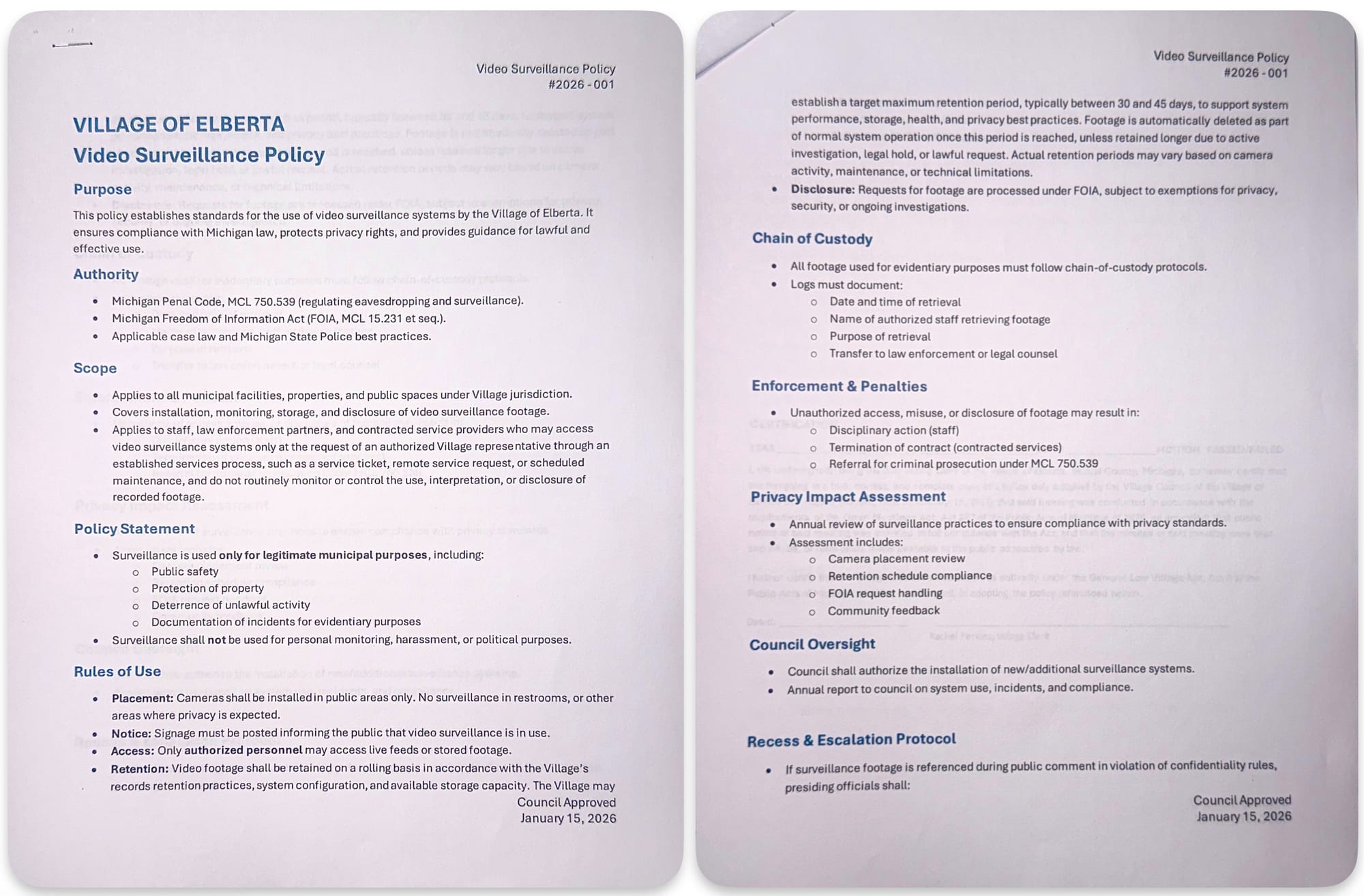
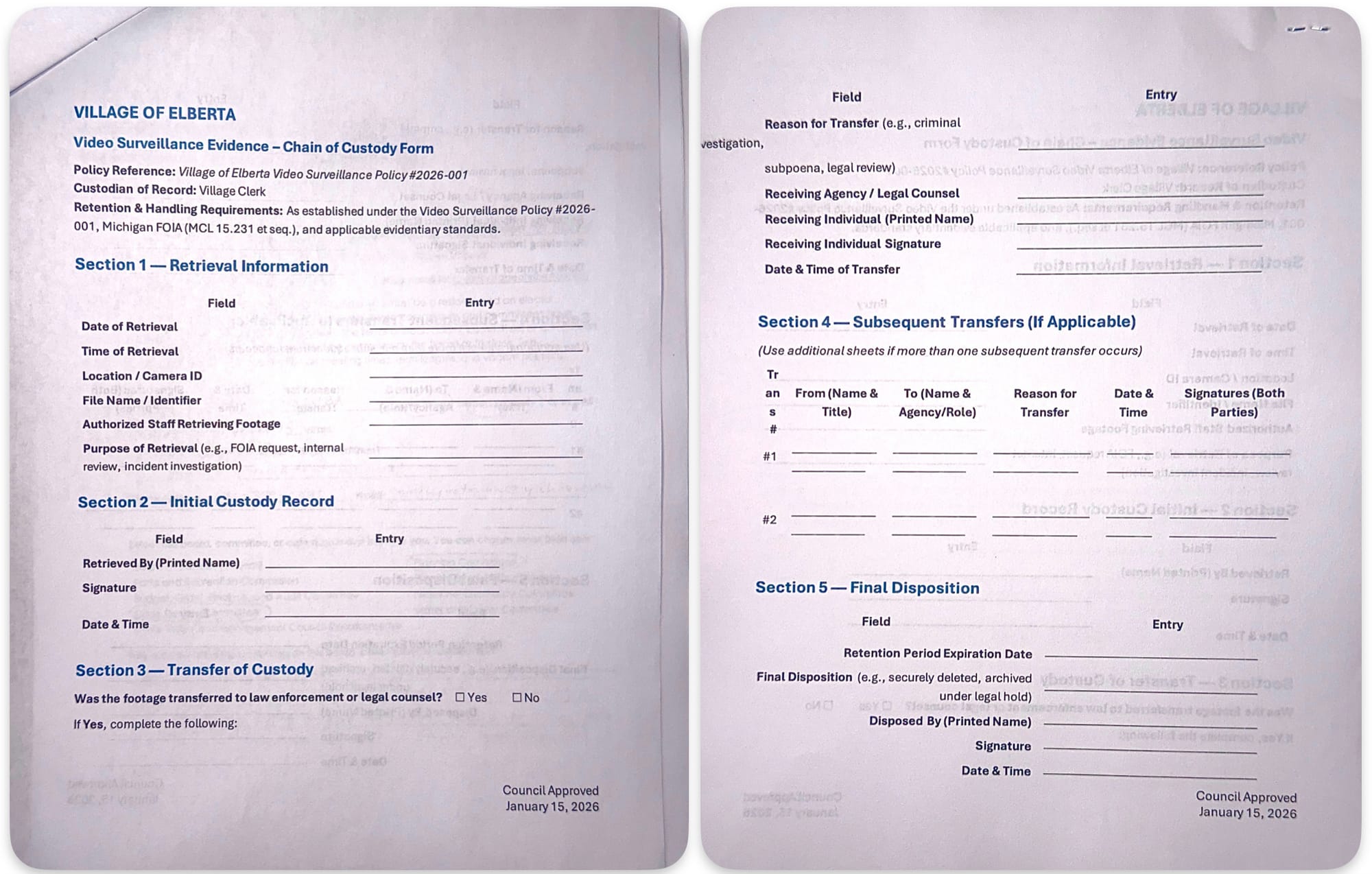
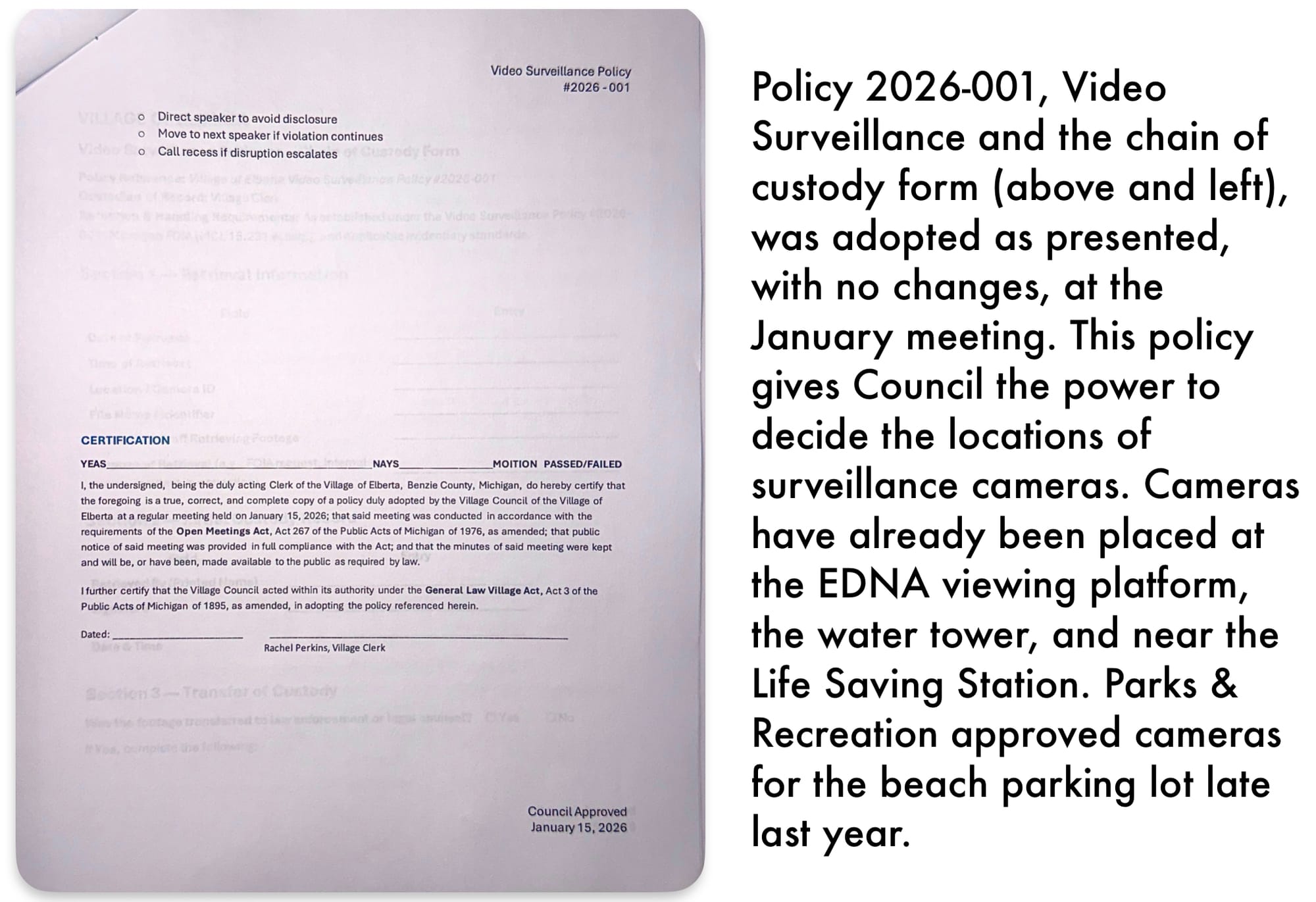
Lights, Cameras, Surveillance
Fiebing said he thought the policy was robust, and liked that council had oversight and that there would be an annual report to council on the system’s use. The policy was approved unanimously with no further discussion.
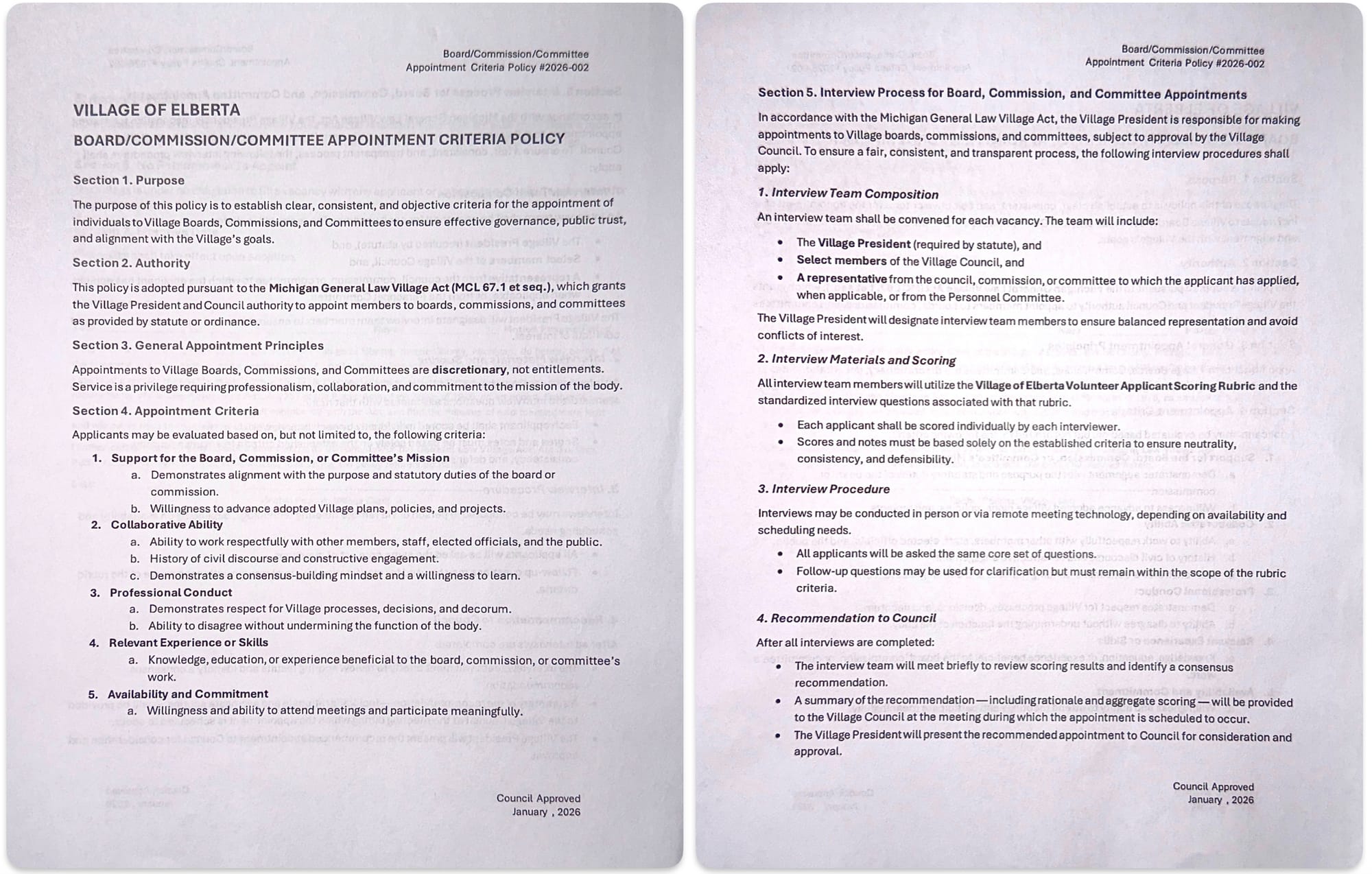
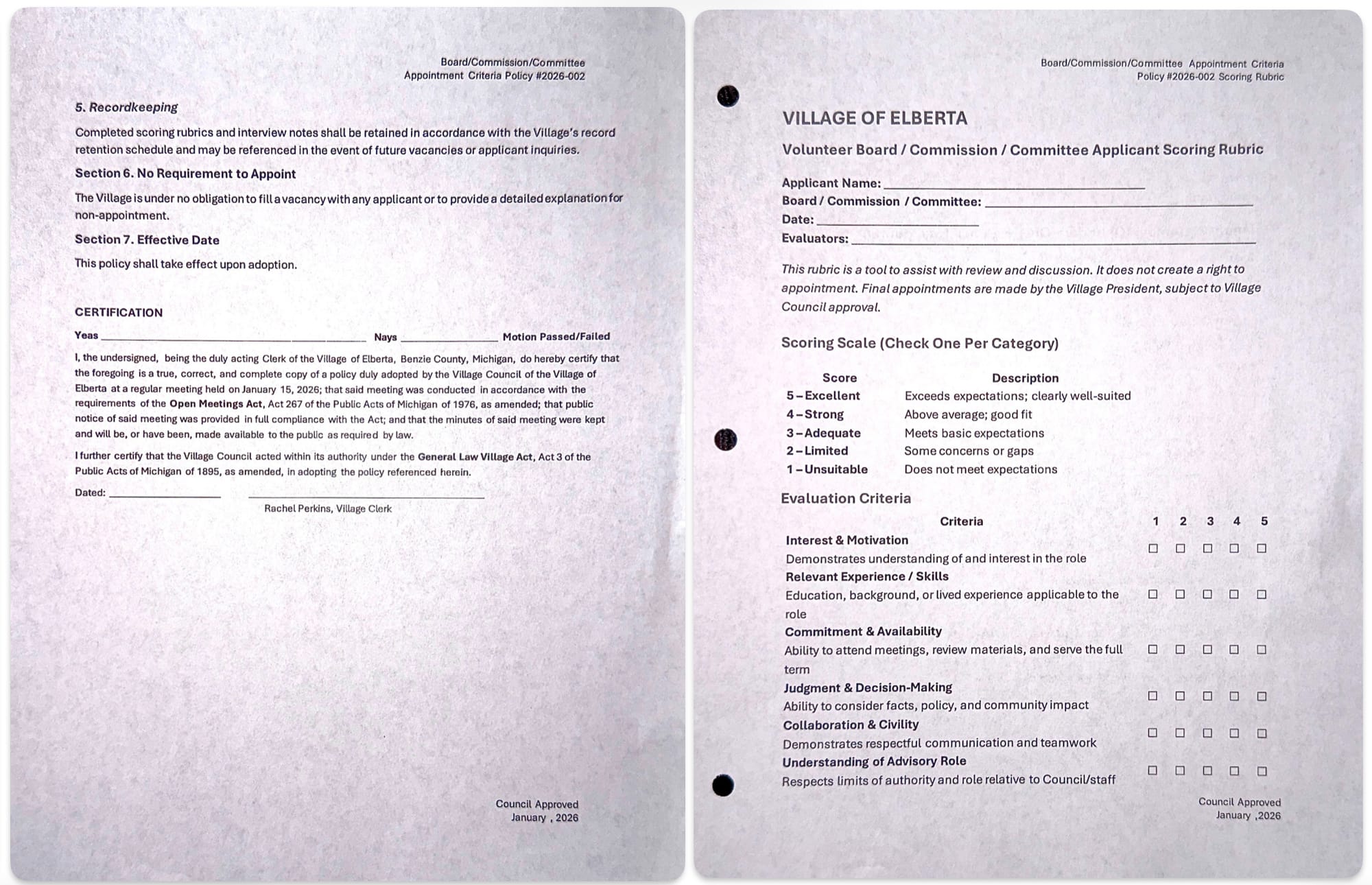
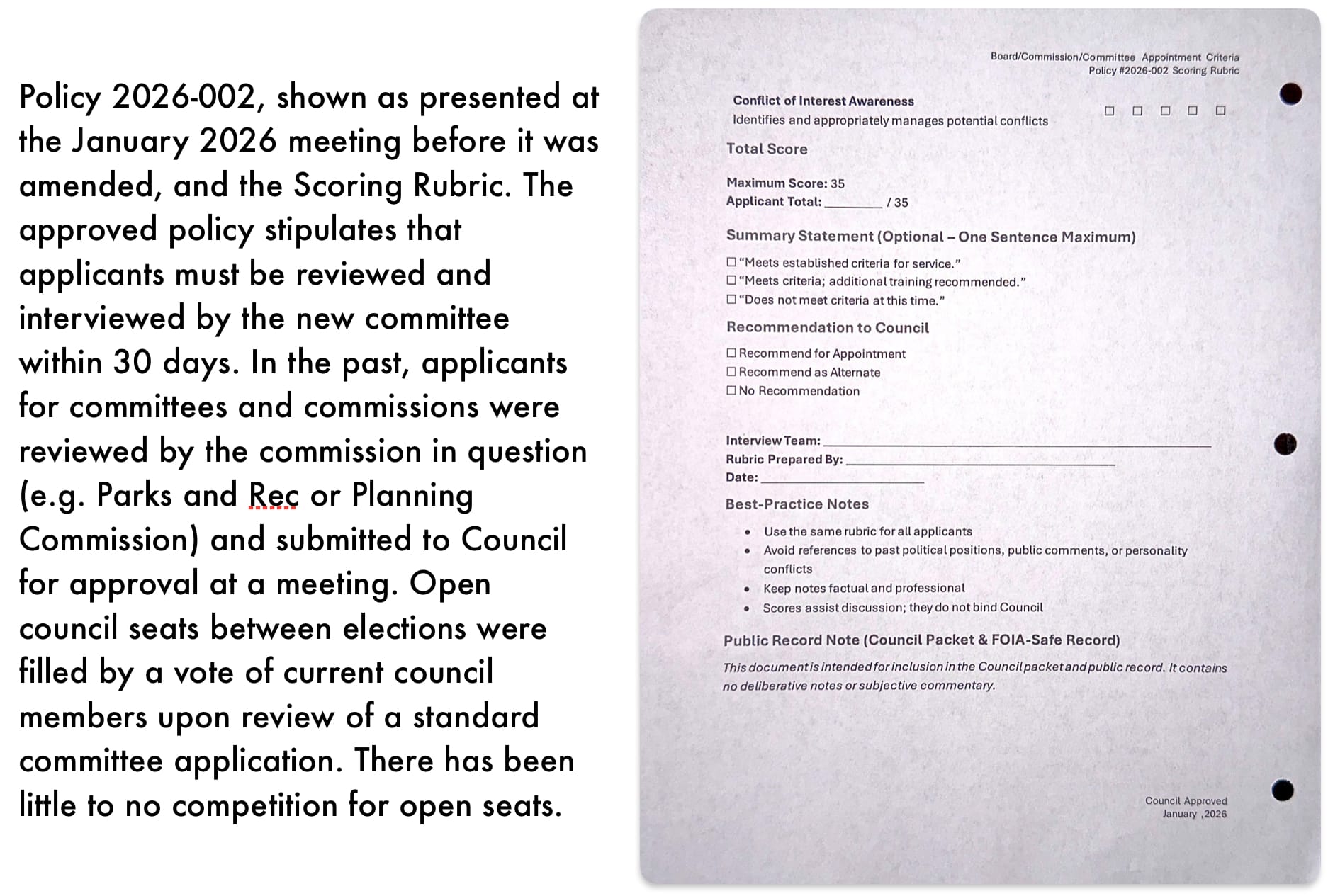
Board/Commission/Committee Appointment Criteria Policy With Volunteer Applicant Scoring Rubric
“We didn’t have this problem in the past,” Wilkins said [for example, in December], “but now, I think it’s a good thing that we have multiple applicants, it’s a good problem, and I look forward to this process, to be able to interview everyone with other people. That’s what this policy allows. That it’s not just me deciding who to recommend.
“It includes the process, which is helpful to me, the president, and any other president that comes after, and it includes the process for the interview team itself. … I have a small amendment from the attorney. The interview team is the Personnel and Policy Committee (President, Pro Tempore, PPC Chair), and upon invitation, a representative from the commission or committee can be invited to interview as well, because perhaps a person on the commission or committee has more information or more background on said committee or commission than the Personnel Committee.”
Bill O’Dwyer said, “If we put this in place tonight, can we move on to the next meeting to vote on the planning commission [applicants]? This won’t slow us down? This team meeting will be completed before the next meeting?”
Wilkins: “Absolutely. People will be interviewed before the next meeting. So we will come to the table with recommendations. I apologize for the delay. I apologize to every applicant.”
Fiebing: “Should there be a time limit to the policy, if we receive an application the interview has to proceed within 30 days? Just so that’s in there? Ultimately I agree that having a policy that very literally states our criteria for how we do our appointments is helpful, but maybe a time constraint.”
Holmes: “There should be a time limit. One person can’t do it all.”
Wilkins: “Within 30 days of application receipt?”
Fiebing: “Yeah, that makes sense.”
Codification Bids
The sheet created by Wilkins for New Business #6, which is in the packet, contains this helpful description: “The Village has solicited bids for the codification of all Village ordinances to ensure accuracy, accessibility, and ongoing legal compliance. American Legal and Civic Plus have submitted proposals to provide these services, which is attached for review.” From what I can tell from the proposals, these companies take our pile of codes and ordinances that have been cobbled together over the decades, weed out or merge the redundant ones, restyle and respell them all so they’re consistent, organize or group them in a way that makes sense, make sure they conform with current format standards, put them all in a binder with tabs and things, and make a searchable digital version. And they have a lawyer who will review them and write a report, probably telling us how weird and unenforceable most of them are (my opinion and speculation added).
O’Dwyer asked who would be faster and easier for Rachel to deal with. Wilkins said American Legal. “Their baseline is $10,400 and you can add different services.” Rachel indicated that dealing with CivicPlus so far had created more work than it saved, even without contracting with them, as, for one thing, they wanted to schedule two Zoom meetings. (I hear that.) Council voted to contract with American Legal Publishing. Get ready for some smoove-reading codes.
Commissioner Sauer’s Report
The government center now opens at 8:30 a.m. Don’t try to go there at 8. They’re doing that because the courts don’t open till 8:30 for some reason. O’Dwyer asked if that applied to the Building Department too and Sauer said yes. An Animal Control employee has been hired and that department now has Saturday and Sunday hours. The Road Commission got 10 bids for architectural design for their new building; the board of commissioners voted to allow them to seek an $18 million bond to pay for it after we voted down a millage twice. “If you do the square footage it’s not that bad, it’s like $120 a square foot. But most of it is storage. A better garage for the mechanics. The whole nine yards.” Lease discussions are being had or not being had with DHHS, who occupy the downstairs below the commissioners’ room. Art Jeannot is chair again and Rhonda Nye is vice chair. The Conservation District’s funding seems pretty stable, because of grants, except for the loss of some USDA money. The Benzie Bus is in great shape financially and their ridership is up. Chris Hackbarth from DTE is looking to expand out to White Owl and the two Herring lakes: 69,000 feet of new gas line. “They are also talking to the tribe on Hoadley Rd. More power to em. … I didn’t think in my lifetime it would even happen. I can’t get them to come to my house. The hookup fee is going to be about $3,300, which you can pay in monthly installments if you want. They anticipate at least 322 residents.… The other thing I always bring up because I get looks: Joyfield was asked to do a ‘green burial.’ OK. And I guess, most of the cemetery ordinances don’t allow it. I thought they said Crystal Lake allows it, they don’t know where it’s going to go. Sounds like there’s some issues. They either put you in a tree ball or they put you in a pine box or a bag or the worst part I understand is that the ground settles after—the tree ball probably not so much—but, yeah. They tell you there’s no chemicals in the ground. I don’t know why they don’t just do cremations. That’s probably wrong too. But they’ve been approached two or three times in Joyfield about it.” Betsie Valley Trail is pursuing a couple of grants, one for the parking lot on River Rd and to expand from Homestead Rd.
Planning Commission
Fiebing reported that the Commission had approved the site plan for the Elberta Heritage Center, the first site plan review in about three years, so that was exciting, he said. The planning consultant couldn’t make it to the most recent meeting, so to save time and keep working, the tiny two person subcommittee met with the planner over Zoom to go over revisions. They are hoping to do a final review of the ordinance at the February meeting and schedule the public hearing.
DPW
Cervantes said he and new DPW Assistant Devan Niemi have been trying to stay on top of plowing. (As of January 23, per the National Weather Service, there’s been nearly 80 inches of snow recorded in Traverse City.)
Clerk & Treasurer
They had submitted brief written reports. Getting a new person logged into the various State of Michigan systems takes a crazy long time and is very frustrating (I tried it) and Melanie Cederholm is going through that now.
Utility Billing
Jon Ottinger thanked Chris and Devan for getting the snow cleared so he could read meters. “I’ve been remiss in not thanking the council for the new parking lot at the beach last summer. I never had to park above. I could always find a spot below, and that hasn’t happened in a long time. You had a little bit to do with that too, Ken, with AJ.”
Budget Committee
Wilkins said there had not been a budget meeting but there would be several before February 2.
Personnel and Policy
“We’ve covered numerous policies,” Wilkins said. “We have three more in the docket. We’re kicking them out as fast as we can and as accurately as we can, taking time. I appreciate everybody involved. Those processes don’t move as quickly as some people would like, but sometimes we need the time to really mull things over and be sure it’s going to work for our area.”
BLUA
Holmes said, “They can’t finish. They have to wait anywhere from two weeks to a month to get the rest of the parts they need. Then it’ll take another month to get the stuff put together. Both the new houses they built are finished but they don’t have the equipment to put in them.” Wilkins said work is proceeding in a heated trailer despite the cold.
Development Committee
Wilkins said the committee will meet soon to discuss all the exciting things that will come this year.
Public Comment
Some of the more fun public comments from this meeting I already covered in an earlier post.
Jay White plugged the housing conversation happening February 11 at the Mills House, which will be led by Ryan Kilpatrick, who spearheaded the snowbound talk of December 2024. (This new event is posted on the Village website now too.)
Arlene Sweeting said, “As someone who likes to see more civic engagement and participation, I have a little concern when the public doesn’t have a chance to review or comment on policies before they’re passed by council.” She had requested copies of the policies but hadn’t received them, acknowledging that like me she had only noticed the agenda the day before the meeting. She suggested putting links to any policies [or maybe other items!] in the agenda on the website so the public could have access before the meeting.
The Future of Elections in Elberta
Arlene has also been writing the Benzie Dems Lookout report for Gilmore Township. (You can subscribe to these concise and informative dispatches and read the ones archived here on the Dems’ site.) At the most recent Gilmore meeting she learned that the township board is thinking about holding elections in combination with Benzonia and Joyfield Twp at the new Benzonia Town Hall as a money- and staff-saving measure for early voting in the primary and general elections in 2026. If it goes well, they might even have us vote in Benzonia on Election Day itself in future years. This is partly because the state is requiring townships to buy new voting equipment. If you have thoughts, express them to Dan Carter and David Beaton, your Elberta representatives on the Gilmore board! Gilmore needs election workers, and there’s a training in June. (Maybe if we had enough election workers, you wouldn’t have to vote in Bumzonia.—Ed.)
Also per Arlene, WUWU is having regular open houses in the morning from 10 to noon on Fridays in the new Elberta Heritage Center space and radio station. You can peek in at that time and say what’s up with you.
I commented that I was one of the applicants for the planning commission posts and I outed Dan Carter as a fellow applicant (he was in the audience). I said I didn’t know who the third applicant was (I didn’t at the time) and that I’d be interested to know, as a resident. “I also think it’s a great problem to have that people are interested in these positions. But I feel a little bad because I feel like if I hadn’t been one of the people who applied, that position would already have been filled.… I think the public has a right to see a full process of review by the board, and see what questions are asked and see how they’re answered.” At this point I hadn’t seen the policy, hadn’t seen the criteria, didn’t know that the third person (the stated reason for the policy) hadn’t applied until a week before the meeting, and didn’t know who was supposed to be on this interview committee, helping the president decide who to recommend.
I’m pretty interested to see what happens next though.
In 2025 the Planning Commission started getting paid: $25 per meeting for members and $75 per meeting for the chair. ↩